Connect with us

Business

Cryptocurrencies Suffer Second-Worst Crash of 2024

Published

on

Crypto-Pak vs World

Cryptocurrencies had their second-most awful week by week drop of 2024 as worldwide financial backers chilled their inclinations in Bitcoin trade exchanged reserves (ETFs).

The main 100 Cryptocurrencies slid 5% throughout the last week, the market’s most horrendously awful decay since April, Bloomberg detailed.

Bitcoin dipped under $63,000 on Monday, sliding to its most minimal level since May. This comes as the crypto market keeps on causing misfortunes for the sixth continuous day since last week because of enormous disarray in US markets on regardless of whether the Central bank would cut its key loan cost. Request has dropped enormously subsequently as financial backers stop buys and hang tight for clearness.

A specialist said the ongoing downturn is set apart by low unpredictability, delicate volumes, and lopsided request books when costs approach the edges of their reach.

Cryptocurrencies represent a significant innovation in the realm of digital finance, fundamentally altering how value is transferred, stored, and perceived. Originating from the concept of decentralization, these digital assets operate independently of central authorities such as governments and banks, using a technology known as blockchain. Blockchain is a decentralized ledger that records all transactions across a network of computers, ensuring transparency, security, and immutability of the transaction records. Bitcoin, introduced in 2009 by an anonymous entity known as Satoshi Nakamoto, was the first cryptocurrency and remains the most well-known and valuable.

The appeal of cryptocurrencies lies in their decentralized nature, which offers a level of financial privacy and freedom from governmental and institutional oversight. Unlike traditional fiat currencies, the supply of many cryptocurrencies, particularly Bitcoin, is limited and follows a predetermined schedule, making them resistant to inflation. Bitcoin’s creation process, known as mining, involves powerful computers solving complex mathematical problems to validate transactions and secure the network, rewarding miners with new coins.

The cryptocurrency market has since expanded, giving rise to thousands of alternative cryptocurrencies, or altcoins. Ethereum, for instance, introduced in 2015, brought the concept of smart contracts to the forefront. Smart contracts are self-executing contracts with the terms directly written into code, enabling the creation of decentralized applications (dApps) that operate without intermediaries. This innovation has spurred the growth of decentralized finance (DeFi), which aims to recreate traditional financial systems such as lending and borrowing using blockchain technology.

Despite their potential, cryptocurrencies face several significant challenges. One of the primary issues is price volatility. The value of cryptocurrencies can fluctuate wildly in short periods, leading to market instability and making them less reliable as a store of value or medium of exchange. This volatility is partly driven by speculation and the relatively immature state of the market.


Ethereum (ETH) and Solana have had one of their most horrendously awful ever downgrades up to this point. ETH is as of now on its longest run of week after week declines starting around 2023 while Solana, when a worldwide #1 among computerized resource mutual funds, is on its most terrible descending downturn starting around 2022.

It bears referencing that Bitcoin arrived at an unequaled high of $73,798 in Spring however has failed to meet expectations contrasted with conventional resources like stocks, bonds, and gold this quarter.

At the hour of documenting, the leader Cryptocurrencies was down 3.14 percent and exchanging at $62,375
Business

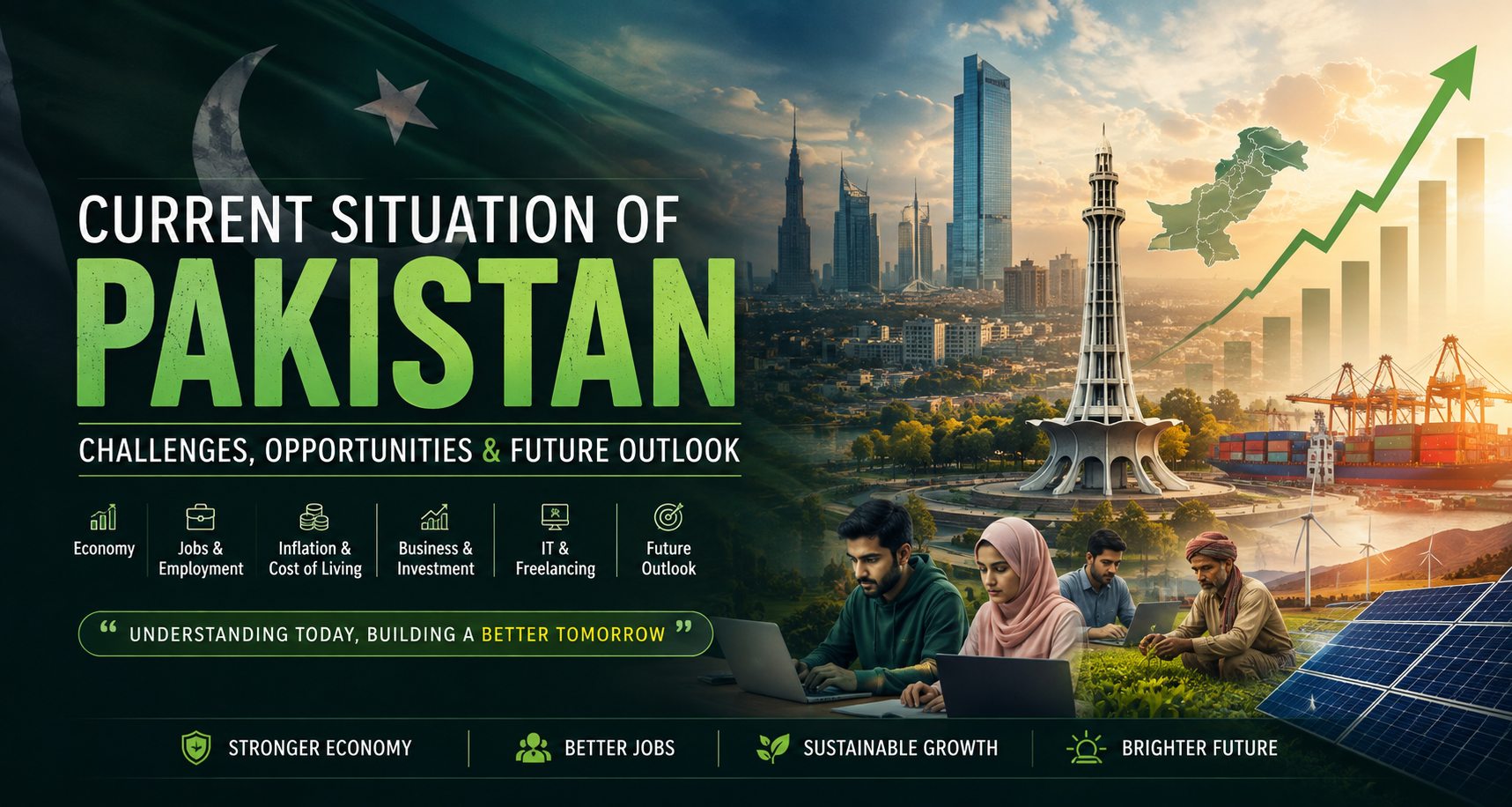
Current Situation of Pakistan: Economy, Jobs, Politics & Future Outlook

Published

on

By

AI Pakistan, pakistan economy, pakistan, pakvsworld

Pakistan is going through an important phase of economic and social change. The current situation of Pakistan is being shaped by inflation, employment challenges, economic reforms, political developments, the exchange rate, energy costs and the country’s efforts to attract investment. At the same time, Pakistan continues to have significant opportunities in technology, exports, freelancing, agriculture, manufacturing and digital businesses.

For ordinary people, the biggest concerns remain inflation, unemployment, cost of living, electricity prices and job opportunities. However, there are also positive developments that could support economic growth if reforms and investment continue.

Pakistan Economy and Current Economic Situation

The Pakistan economy has faced several difficult years, including high inflation, foreign-exchange pressures, rising debt servicing costs and a shortage of investment. The government and economic institutions have been focusing on improving fiscal management, increasing tax revenues, controlling expenditures and strengthening foreign-exchange reserves.

One of the biggest challenges is the cost of living in Pakistan. Food, electricity, transportation, healthcare and education expenses have placed pressure on household budgets. Even when inflation slows, consumers can continue to feel the impact because prices remain significantly higher than they were several years ago.

The performance of the Pakistani rupee also remains important. Changes in the USD to PKR exchange rate directly affect imported products, fuel, machinery and many business costs.

Inflation and Cost of Living

Inflation in Pakistan has been one of the most searched and discussed economic issues among the public. Rising prices have affected both salaried employees and small businesses.

Lower-income families are particularly affected because a larger portion of their income goes toward food, utilities and transportation. Middle-class households are also facing pressure as housing, education and healthcare costs continue to consume a significant share of monthly income.

Controlling inflation while maintaining economic growth is therefore one of Pakistan’s major economic challenges.

Jobs and Employment in Pakistan

The job market in Pakistan remains competitive. Young people entering the workforce are increasingly looking for opportunities in IT, digital marketing, software development, sales, customer support, healthcare, accounting and other professional fields.

The growth of remote jobs in Pakistan has created new opportunities. Pakistani professionals can now work with companies in the USA, UK, UAE, Canada and other international markets without physically relocating.

Freelancing is another important source of income. Platforms and international clients have helped Pakistani freelancers earn foreign currency through services such as:

  • Software development
  • Graphic design
  • Digital marketing
  • SEO
  • Content writing
  • Video editing
  • Virtual assistance
  • E-commerce services

The technology sector could become an important part of Pakistan’s future employment market if investment in digital infrastructure and skills continues.

Business and Investment Opportunities

Despite economic challenges, Pakistan remains a large consumer market with a population of more than 240 million people. This creates opportunities for businesses in e-commerce, technology, agriculture, healthcare, education, logistics and manufacturing.

Small and medium-sized businesses are particularly important for employment. Digital platforms have also made it easier for entrepreneurs to sell products and services locally and internationally.

Foreign investment remains an important priority. Greater economic stability, predictable policies, better infrastructure and improved ease of doing business could help Pakistan attract more foreign direct investment (FDI).

Pakistan’s IT and Digital Sector

The IT sector in Pakistan is one of the areas with strong growth potential. Software houses, freelancers, startups and technology companies are increasingly serving international clients.

Pakistan has a large population of young, tech-oriented workers. With appropriate training in artificial intelligence, software development, cybersecurity, cloud computing and digital marketing, the country could increase its technology exports.

The rise of AI in Pakistan is also creating new opportunities and challenges. Businesses are adopting AI tools to improve productivity, marketing, customer service and software development, while workers are increasingly required to learn new digital skills.

Pakistan and International Jobs

Another major trend is the increasing interest in jobs in Dubai, UAE jobs, Saudi jobs, Qatar jobs and international employment opportunities.

Many Pakistani professionals seek overseas employment because of higher salaries, career development and better international exposure. The Gulf region remains particularly attractive because of its proximity to Pakistan and demand for skilled workers.

However, people searching for overseas jobs from Pakistan should always verify recruiters and employers before paying any fees or sharing sensitive information. Genuine employers generally provide clear job descriptions, employment terms and official application channels.

Political and Social Challenges

The political situation in Pakistan continues to influence economic confidence and business decisions. Political uncertainty can affect investment, consumer confidence and long-term planning.

At the same time, Pakistan faces broader social challenges, including population growth, education, healthcare, urbanization and the need to create enough productive jobs for its young population.

Improving education and professional training will be essential for ensuring that Pakistan’s growing workforce can participate in higher-value industries.

What Is the Future of Pakistan?

The future of Pakistan will depend on how effectively the country addresses its structural economic problems. Sustainable growth will require stronger exports, increased investment, better tax collection, energy-sector reforms, improved governance and greater support for productive industries.

There is also significant potential in IT exports, freelancing, agriculture, renewable energy, e-commerce and manufacturing.

Pakistan’s large domestic market and young workforce are important advantages. If economic stability improves and businesses receive a more predictable environment, these strengths could contribute significantly to long-term growth.

Conclusion

The current situation of Pakistan is a combination of serious challenges and significant opportunities. Inflation, unemployment, political uncertainty and the cost of living continue to affect millions of people. At the same time, the country has opportunities in technology, exports, freelancing, entrepreneurship and international employment.

For individuals, developing digital skills, professional qualifications, English communication and international work experience can improve access to both local and global opportunities.

Pakistan’s economic recovery will not happen overnight, but continued reforms, investment and growth in productive sectors could help create a more stable and prosperous future.

Continue Reading

Business

Latest Dubai & Pakistan Jobs: Opportunities, Job Application Tips & Career Guide

Published

on